
A waking watch service is a temporary fire safety measure where trained, SIA licensed officers patrol a building continuously to detect fire risk and manage evacuation, used when a building’s fire alarm system or cladding can’t be fully relied on. Costs typically range from £12 to £30 per hour, and most buildings aim to replace it with a proper fire alarm system as soon as possible.
If you manage a residential block, especially a high-rise, you may already have been told you need a waking watch service, often by a fire risk assessor or the fire service, without much explanation of what that actually involves, how long it lasts, or what it costs. This guide answers all of that clearly.
What Is a Waking Watch Service, Exactly?
A waking watch is a human-led fire safety measure. Trained officers continuously patrol a building, both inside and around the perimeter, watching for early signs of fire and ready to raise the alarm and manage evacuation immediately if something happens.
How a Waking Watch Differs From an Automated Fire Alarm
An automated fire alarm system detects smoke or heat electronically and triggers an alert. A waking watch exists specifically for situations where that system can’t be trusted on its own, whether it’s out of service, unreliable, or the building’s cladding presents a risk an alarm alone can’t manage. A trained officer can physically inspect corridors, stairwells, and external walls in a way no sensor can. It’s a stopgap measure, not a permanent fix, used while the underlying fire safety problem gets properly resolved.
Why Waking Watches Became So Common in the UK
The Impact of the Grenfell Tower Fire
Waking watches existed before 2017, but they became far more widespread after the Grenfell Tower fire, which exposed how dangerous certain types of cladding and fire safety failures could be in high-rise residential buildings. In the years since, buildings found to have unsafe cladding, missing fire breaks, or non-compliant fire detection systems have often needed an interim safety measure while remediation work is carried out, and a waking watch service is frequently that measure.
Stay Put vs Simultaneous Evacuation: Why It Matters
Most UK residential blocks traditionally operate a “stay put” strategy, residents remain in their own flat during a fire elsewhere in the building, because the building’s construction is designed to contain fire to one unit. When cladding or compartmentation issues mean that’s no longer safe, buildings often switch to a “simultaneous evacuation” strategy instead, meaning everyone leaves at once if a fire is detected anywhere in the building.
A waking watch service is frequently introduced specifically to support this switch, since simultaneous evacuation depends on someone being able to detect a fire quickly and coordinate a safe, full evacuation, exactly what a waking watch team is trained to do.
Who Decides You Need a Waking Watch Service?
A waking watch isn’t something a building manager chooses on a whim, it’s typically triggered by:
- A fire risk assessment identifying unsafe cladding or fire safety defects
- A fire engineer’s formal recommendation
- Local fire and rescue authority guidance
- A fire alarm or detection system being out of service
- Hot works or other higher-risk activity taking place on site
The Legal Framework Behind Waking Watch Requirements
UK fire safety law places clear responsibility on building owners and managers:
- The Regulatory Reform (Fire Safety) Order 2005 places responsibility on a building’s “responsible person,” usually the freeholder, managing agent, or landlord, to assess and manage fire risk.
- The Fire Safety Act 2021 strengthened this, explicitly extending responsibility to external walls and cladding systems.
- The Building Safety Act 2022 adds further accountability, particularly for higher-risk residential buildings.
Waking watch arrangements are also expected to follow guidance from the National Fire Chiefs Council (NFCC), which sets out best practice for how patrols should be run and when they’re appropriate.
What Do Waking Watch Officers Actually Do?
A Typical Waking Watch Patrol Routine
Day to day, a waking watch team typically:
- Patrols all floors and the building’s exterior continuously
- Checks stairwells, corridors, plant rooms, and other high-risk areas
- Watches for smoke, heat, or fire hazards
- Raises the alarm immediately if a risk is detected
- Coordinates and manages evacuation if needed
- Liaises directly with the fire service during an incident
- Keeps detailed logs and incident reports for compliance and insurance purposes
Waking Watch vs Fire Marshal: What’s the Real Difference?
These two terms get used almost interchangeably, but they’re not the same role, and it’s worth knowing which one your building actually needs.
| Fire Marshal | Waking Watch | |
|---|---|---|
| Coverage | Part-time, alongside other duties | Continuous, 24/7 dedicated patrol |
| Typical use | Normal day-to-day fire safety management | Building’s fire detection can’t currently be relied on |
| Duration | Ongoing, permanent role | Temporary, until the underlying issue is fixed |
| Who fills it | Often an existing staff member, trained | Dedicated, specialist officers |
Many buildings end up needing both at different points, a fire marshal for everyday fire safety management, and a waking watch service specifically during the period when detection systems or cladding are compromised.
How Much Does a Waking Watch Cost in the UK?
Why Waking Watch Costs Add Up Quickly
Costs vary by building size, staffing levels, and location, but published figures give a useful benchmark. According to analysis from law firm Trowers & Hamlins, waking watch officers are typically charged at hourly rates of roughly £12 to £30, with the average monthly cost working out to around £17,897 per building nationally, or about £331 per dwelling. In London specifically, that rises to an average of roughly £20,443 per building, or about £499 per dwelling, reflecting higher staffing costs in the capital.
These are significant, ongoing figures, which is exactly why a waking watch service is meant to be short-term. Government guidance is explicit that it should only be used in exceptional circumstances, for the shortest period possible, while a proper fire alarm system is installed or cladding remediation is completed.
How Long Does a Waking Watch Service Last?
How Buildings Typically Exit a Waking Watch Arrangement
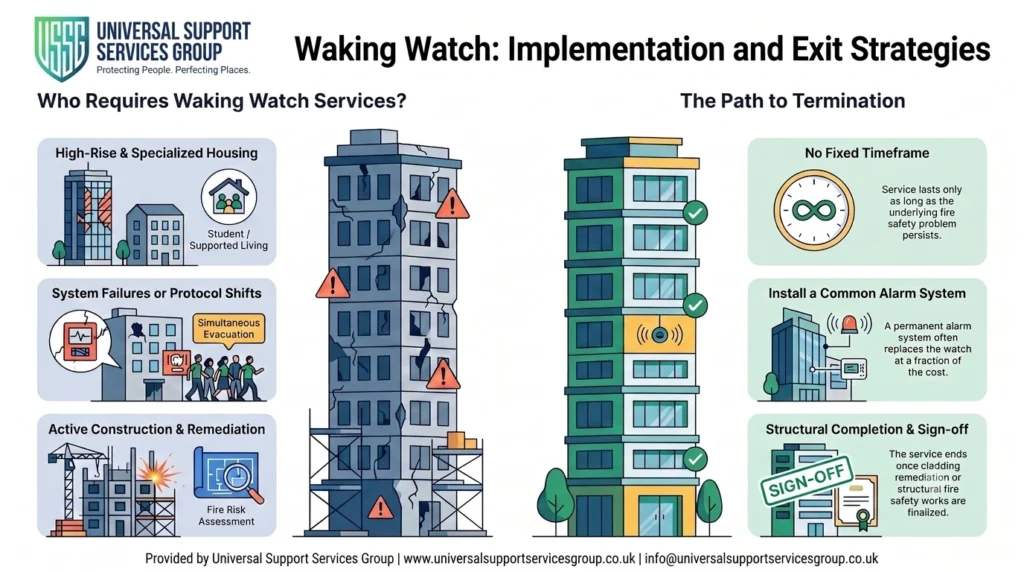
There’s no fixed timeframe, it lasts as long as the underlying problem does. In practice, most buildings move away from a waking watch once one of two things happens:
- A common fire alarm system is installed across the building, which can often fully replace the need for a waking watch, at a fraction of the ongoing cost
- Cladding remediation or other structural fire safety work is completed and signed off
Because of the cost involved, many building owners now prioritise installing a proper alarm system specifically to end the waking watch arrangement as quickly as possible, rather than treating it as a long-term solution.
Who Typically Needs a Waking Watch Service?
- High-rise residential buildings with unsafe cladding
- Buildings that have switched from “stay put” to “simultaneous evacuation”
- Properties with a fire alarm or detection system currently out of service
- Student accommodation and supported living developments with elevated risk
- Construction or refurbishment sites carrying out hot works or requiring site security
- Buildings awaiting a fire risk assessment outcome or remediation works
Waking Watch and Martyn’s Law: What Building Managers Should Know
Alongside fire safety obligations, building and venue managers should also be aware of the Terrorism (Protection of Premises) Act 2025, known as Martyn’s Law, which introduces new security duties for premises expecting significant numbers of people. While Martyn’s Law is separate from fire safety legislation, many of the same buildings affected by waking watch requirements, high-rise residential blocks, mixed-use developments, student accommodation, are also reviewing their broader security and emergency planning as a result. It’s worth checking both sets of obligations together rather than in isolation.
Why Choose USSG for Waking Watch Services
Directly Employed, SIA Licensed Officers
USSG has been delivering security and fire safety services across the UK since 2016. Every waking watch officer we deploy is directly employed, not subcontracted, and fully SIA licensed, vetted to BS 7858 standard before ever setting foot on site. We work directly with your fire risk assessor and building manager to deliver a fully documented service that meets your building safety case requirements.
Complementary Services We Offer Alongside Waking Watch
Many buildings pairing a waking watch service also need related cover. USSG also provides key holding and alarm response for out-of-hours incidents, CCTV monitoring as a complementary layer of coverage, and general manned guarding for buildings that need broader site security alongside fire safety patrols. For buildings that sit vacant during remediation works, our vacant property inspection service is also worth considering.
If you’re trying to work out whether your building actually needs a waking watch service, or you already know you need one and want a straightforward quote, see our waking watch services page or get in touch with our team directly.
Frequently Asked Questions
Is a waking watch the same as having a fire warden?
Not quite. A fire warden or fire marshal typically manages fire safety part-time as part of an existing role. A waking watch is a dedicated, continuous 24/7 patrol, used specifically when a building’s normal fire detection can’t be relied on.
Can a waking watch be replaced by a fire alarm system?
Yes, and in most cases this is the goal. Installing a compliant common fire alarm system across a building can remove the need for a waking watch entirely, and is usually far more cost-effective long term.
Who pays for a waking watch?
This is typically covered through the building’s service charge, though costs and responsibility can vary depending on the lease, freeholder, and whether any government remediation funding applies to the building.
Does every high-rise building need a waking watch?
No. It’s only required where a fire risk assessment, fire engineer, or fire and rescue authority has identified a specific risk, such as unsafe cladding or a non-functioning alarm system, not simply because a building is tall.
How quickly can a waking watch be arranged?
This depends on the provider and building size, but established providers can often mobilise within a short timeframe for urgent cases. Contact USSG directly for a realistic timeline based on your building’s situation.