
Key takeaway: Student accommodation carries meaningfully higher security risk than standard residential property, due to constant visitor turnover, young or first-time-away-from-home residents, and communal access points. UK data shows students in typical university areas face crime rates around 2.5 times the national average, making dedicated, SIA licensed student accommodation security a genuine safeguarding measure, not just an added cost.
If you manage purpose-built student accommodation (PBSA), HMOs, or private halls in the UK, security isn’t optional polish, it’s one of the practical factors students and parents actually weigh when choosing where to live. This guide covers the real risks, what proper student accommodation security services actually involve, and what to look for in a provider.
Why Student Accommodation Carries Different Risks
The Data Behind the Risk
Student housing security is a genuinely different risk category from standard residential property, and the data backs this up. A survey by StuRents.com, covering over 535,000 crimes across 64 university towns and cities in England and Wales, found that students commonly live in areas with crime rates around 2.5 times higher than the national average.
Separately, a Neighbourhood Watch Network survey of students found that 53% were most concerned about serious violence and 52% about sexual crime, yet only 35% said they’d actually received any personal safety guidance from their university or accommodation provider, despite 86% saying they’d act on that advice if given.
Why Student Accommodation Is a Different Kind of Site
A few things make student housing genuinely different from a standard office or residential building:
- Constant visitor traffic, friends, deliveries, guests, coming and going at all hours
- Residents who are often living independently for the first time, sometimes far from home or from overseas
- Communal areas (kitchens, common rooms, laundry, study spaces) that see heavy, unsupervised footfall
- A higher rate of late-night activity and social events on site
- Vulnerable periods where risk spikes sharply across the academic calendar
Types of Student Accommodation That Need Security
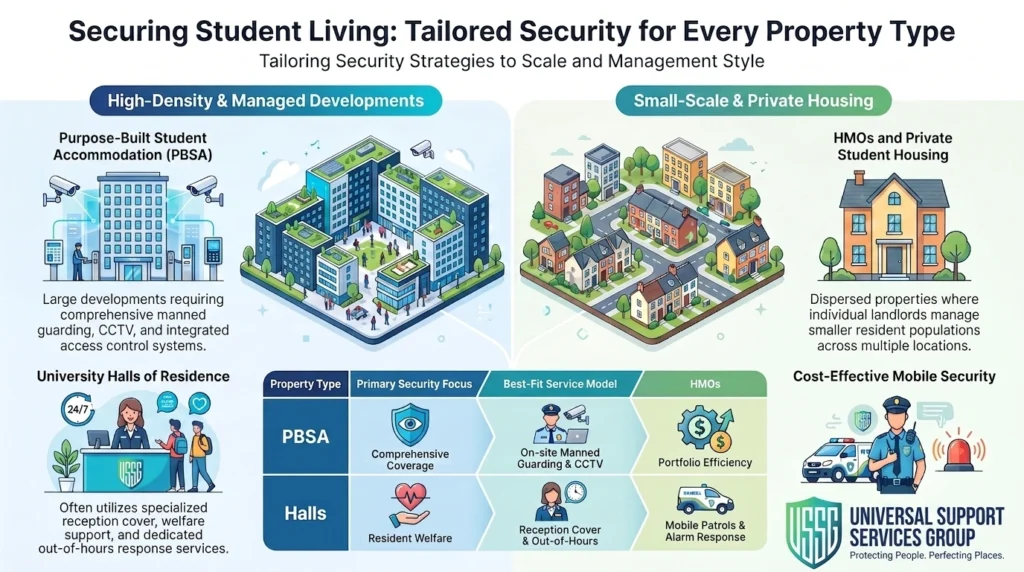
Student accommodation security needs vary significantly by property type:
Purpose-Built Student Accommodation (PBSA) Large, dedicated developments with communal areas, reception desks, and often hundreds of residents. These typically need the most comprehensive coverage, manned guarding, CCTV, and access control working together.
University Halls of Residence Often university-managed, but increasingly outsourced to specialist security providers for reception cover, welfare support, and out-of-hours response.
HMOs and Private Student Housing Smaller, dispersed properties that individual landlords manage. These often benefit most from mobile patrols and key holding and alarm response rather than a full-time on-site officer, a more cost-effective model for smaller portfolios.
Peak Risk Periods Across the Academic Year
Risk isn’t constant, it spikes at predictable points, which is worth building into any security plan:
- Freshers’ week, high alcohol consumption, unfamiliar surroundings, residents meeting people for the first time
- Exam periods, elevated stress, mental health concerns, disrupted sleep patterns increasing vulnerability
- End of term and move-out, empty properties, valuable items left unattended, higher theft risk
- Summer holidays, many PBSA and university-owned buildings sit partially or fully vacant, exactly the kind of period our vacant property inspection service is designed for
What Does Student Accommodation Security Actually Involve?
Core Coverage Most Providers Need
Depending on the size and type of property, student accommodation security services typically include:
- Manned guarding at entrances and reception during peak hours
- CCTV monitoring across communal areas and access points
- Access control, ensuring only residents and authorised visitors can enter
- Mobile patrols overnight for larger or multi-building sites
- Key holding and alarm response for out-of-hours incidents
- Waking watch cover for buildings undergoing fire safety remediation, a real, growing issue for older student blocks with cladding concerns
- Event security for large communal socials, balls, or freshers’ events held on site
The Welfare Side of the Role
Good student accommodation security isn’t just about preventing break-ins. Officers working in this sector often end up as a genuine point of contact for residents dealing with a lockout, a noise dispute, or simply feeling unsafe late at night. That’s different from standard commercial guarding, and it’s worth asking any provider directly how their officers are trained to handle welfare situations, not just security incidents.
Student Accommodation Security vs Standard Manned Guarding
| Standard Manned Guarding | Student Accommodation Security | |
|---|---|---|
| Primary focus | Access control, asset protection | Access control, resident welfare, and safety |
| Resident profile | N/A, commercial site | Often young, first-time-independent residents |
| Peak risk periods | Working hours, overnight | Freshers’ week, exam stress, end of term |
| Officer skills needed | Standard SIA licensing | SIA licensing plus welfare awareness training |
| Common pairing | CCTV, key holding | CCTV, key holding, waking watch, event security |
Why Security Directly Affects Occupancy and Reputation
For accommodation providers, security isn’t just a safeguarding cost, it’s a genuine factor in occupancy rates. Parents and international students in particular actively research safety before committing to a booking, and providers who can point to visible, professional SIA licensed security have a real, marketable advantage over those who can’t. A single serious incident, and how visibly a provider responded to it, can shape a building’s reputation for years.
Compliance: What Providers Should Be Aware Of
Larger student accommodation sites, particularly those hosting communal events, socials, or expecting significant numbers of people at once, may fall within scope of the Terrorism (Protection of Premises) Act 2025, known as Martyn’s Law, depending on capacity. It’s worth checking where your property sits as implementation guidance develops, particularly for larger PBSA developments with shared event or social spaces.
Buildings with older cladding or fire safety concerns should also be aware of ongoing waking watch and fire safety obligations under the Building Safety Act 2022, a genuine, active issue across a meaningful share of the UK’s student housing stock, not a rare edge case.
Why Landlords and Providers Choose USSG
USSG has worked with Vita Student, one of the UK’s established student accommodation providers, delivering exactly this kind of on-site student accommodation security and welfare-aware guarding. Every officer we deploy is directly employed, not subcontracted, SIA licensed, and vetted to BS 7858 standard before ever setting foot on site.
We typically pair student accommodation security with our manned guarding service for reception and access control, CCTV monitoring across communal areas, and key holding and alarm response for out-of-hours cover. For older buildings undergoing fire safety works, our waking watch services provide compliant interim cover while remediation is completed, and for buildings sitting empty over summer, our vacant property inspection service keeps sites protected until residents return. You can see our full range of cover on our security services UK page.

How to Choose a Student Accommodation Security Provider
Worth asking before signing anything:
- Are officers directly employed, or subcontracted through an agency?
- Do officers receive any welfare or mental health awareness training, not just standard security training?
- Can they provide references from other student accommodation or PBSA clients specifically?
- Is there a dedicated point of contact available out of hours, not just a call centre?
- Are they SIA licensed, and can they prove it for the specific officers assigned to your site?
Frequently Asked Questions
Is student accommodation actually higher risk than standard housing?
Data suggests yes. A StuRents.com survey covering over 535,000 crimes across UK university areas found students commonly live in areas with crime rates roughly 2.5 times the national average, largely reflecting dense, high-footfall student neighbourhoods rather than the buildings themselves being inherently unsafe.
Do all student accommodation buildings need a security officer?
Not necessarily. Smaller, low-footfall properties may be adequately covered with CCTV and access control alone. Larger PBSA developments, buildings with communal social spaces, or sites with a history of incidents typically benefit from dedicated on-site guarding.
What’s different about training for student accommodation security officers?
Beyond standard SIA licensing, officers working in this sector benefit from welfare and mental health awareness training, since they’re often a resident’s first point of contact during a personal crisis, not just a security incident.
Does Martyn’s Law apply to student accommodation?
It depends on capacity and whether the site hosts events or communal gatherings expecting significant numbers of people. Larger PBSA developments with shared social spaces are more likely to fall within scope, worth checking as guidance develops.
What happens to security when a student building sits empty over summer?
Many PBSA and university-owned buildings are partially or fully vacant over summer, which is when a dedicated vacant property inspection service becomes important, protecting the site from unauthorised entry, vandalism, and theft until residents return.
How much does student accommodation security cost?
This depends on site size, hours of cover, and whether welfare-trained officers are required. Contact USSG for a tailored quote based on your specific property.
If you manage student accommodation and want to talk through what level of security actually makes sense for your property, get in touch with USSG for a straightforward assessment.