
Quick answer: most property insurers treat a building as unoccupied after a set period, usually 30 or 60 days. From then on, cover such as theft, malicious damage and escape of water is often restricted unless you meet the policy conditions. Those conditions usually include regular, recorded inspections, keeping the building secure and managing water, utilities and waste. Your own policy wording always decides.
- 30 or 60 daystypical point at which a policy treats a building as unoccupied
- Regular visitsinspections at the frequency your policy sets, recorded every time
- Written logevidence you met the conditions if you ever need to claim
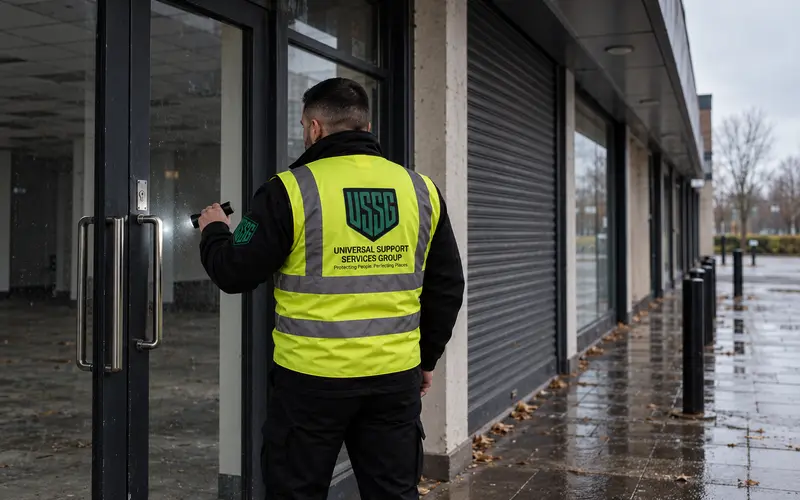
An empty office, shop, warehouse or industrial unit is at higher risk than an occupied one. Nobody is there to notice a leak, a broken window or someone forcing a door. That is why insurers change the rules once a building has been empty for a while, and why a missed inspection can turn a simple claim into a dispute.
This guide is written by Universal Support Services Group (USSG), an SIA Approved Contractor based in Stockport that provides vacant property inspections, key holding and patrols across Greater Manchester and the UK. It explains what “unoccupied” means for insurance, what insurers commonly expect, what an inspection should check and how to keep a record that stands up.
This is general guidance, not insurance or legal advice. Every policy is different. Always read your own policy wording, ask your insurer or broker to confirm the conditions in writing, and follow them exactly.
When is a building “unoccupied” for insurance?
There is no single legal definition. According to the Financial Ombudsman Service, many policies do not clearly define “unoccupied”, and a property may be treated as unoccupied after a set period, which is usually 30 or 60 days.
Where a policy does not define the word clearly, the Ombudsman looks at its natural meaning. Regular visits may count, and an insurer should not normally refuse a claim for an event in the first 30 days just because the property was empty. Do not rely on this, though: the safest course is to tell your insurer as soon as a building becomes empty and agree the conditions in writing.
What cover can be restricted when a building is empty?
Once the unoccupancy period starts, some policies reduce or remove cover for certain events. The Financial Ombudsman lists these as typical restrictions:
- Theft or attempted theftEmpty buildings are attractive to thieves looking for metal, cable, fittings and stock.
- Malicious damageVandalism, graffiti and deliberate damage are more likely when nobody is there.
- Escape of waterA burst pipe in an empty building can run for days before anyone notices.
- Other listed eventsYour policy may restrict other cover too, so read the unoccupancy section in full.
The Ombudsman also says that a claim is unlikely to be supported if a property has been abandoned, or neglected so badly that it invites unwelcome attention. Regular, recorded care of the building matters.
What insurers commonly expect for an empty building
Conditions vary between insurers and policies, but these are the requirements owners most often see. Treat this as a list to check against your own wording, not a replacement for it.
- Tell your insurer when the building becomes empty, and again if anything changes.
- Regular inspections at the frequency your policy sets (often weekly, sometimes more often), inside and out, with a written record of each visit.
- Secure the building: all doors and windows locked, and broken locks, glazing or boarding repaired quickly.
- Water: the supply turned off at the mains and the system drained down where required, unless a sprinkler system needs water.
- Gas and electricity: isolated where required, apart from supplies needed for intruder alarms, fire alarms, emergency lighting or sprinklers.
- Alarms kept working: intruder and fire alarms set, maintained and monitored if your policy asks for it.
- Post and waste: letterboxes sealed or post collected, and rubbish and combustible materials removed from inside and around the building.
- Keys controlled: a clear record of who holds keys and who is allowed access.
If you cannot meet a condition, speak to your insurer or broker before the deadline, not after a loss.
What a vacant property inspection should check
A good inspection follows the same route every time, so that changes stand out. These are the points USSG officers typically cover on an agreed, safely accessible route:
Perimeter and access
- Fences, gates and boundaries
- Doors, shutters, windows and locks
- Signs of forced entry or attempted entry
- Fly-tipping, graffiti or damage
Building condition
- Leaks, damp patches or standing water
- Signs that someone has been inside
- Alarm panels and any fault lights
- Post, waste and anything that could burn
Report and follow-up
- Date, time and name of the inspector
- Findings, with photographs where useful
- Changes since the last visit
- Who was told and what action was agreed
An inspection is a visual security and condition check. It does not replace a building survey, a fire risk assessment or specialist checks such as electrical or gas safety inspections.
Keeping an inspection log that stands up
If you ever make a claim, the insurer may ask for proof that you met the conditions. A clear log is the simplest evidence. For every visit, record:
| Item | Example |
|---|---|
| Date and time | 17/11/2026, 09:40 to 10:05 |
| Inspector | Name and company |
| Areas checked | Perimeter, ground floor, plant room, roof access |
| Findings | Rear fire door secure; damp patch in first-floor corridor, photographed |
| Alarm status | Intruder alarm set, no faults showing |
| Action and who was told | Facilities manager emailed at 10:10; plumber booked |
Keep the log for the life of the policy, and longer if a claim is open. Store it somewhere you can find it quickly, not only on paper inside the empty building.
Squatters, arson and water damage
Squatters
In England and Wales, squatting in a residential building is a crime. According to GOV.UK, squatting in a non-residential building, such as an office, shop or warehouse, is not in itself a crime, although damaging the property is. If squatters get in, act quickly: you can apply for an interim possession order if it has been 28 days or less since you found out. GOV.UK explains how to remove squatters. Never try to remove them yourself using force or the threat of force, because that is a crime.
Prevention is far easier than removal. Secure entry points, visible signs of activity and regular visits all make a building less attractive.
Arson
Rubbish, pallets and stored materials inside or next to an empty building can be used to start a fire. Remove waste, keep bins away from the walls and make sure the fire alarm works.
Water damage
Escape of water is one of the most common problems in empty buildings, especially in winter. Draining down the system, where your policy requires it, and checking for leaks on every visit protects the building and your cover.
Business rates on empty buildings
In England, empty property relief usually means you do not pay business rates for the first 3 months a property is empty. Industrial premises, such as warehouses, get a further 3 months. After that, most owners pay full business rates, although some properties, such as listed buildings and those with a rateable value under £2,900, can get relief until they are reoccupied. Rules are different in Scotland, Wales and Northern Ireland, so contact your local council.
Empty buildings can be costly, which is another reason to keep them in good condition and ready to let.
How a security company can help
Many owners, landlords and managing agents use a security company to meet their insurer’s conditions without sending their own staff to empty sites. Depending on the building and the risk, this can include:
- Vacant property inspections on an agreed schedule, with written reports and photographs.
- Key holding and alarm response, so a licensed officer attends if the alarm goes off, day or night.
- Mobile patrols for visible checks at night or at weekends.
- CCTV for remote monitoring of higher-risk sites.
- Manned guarding where the value or risk calls for an officer on site. See how much a security guard costs.
When you brief a provider, share the exact wording of your insurer’s conditions, so that the visit frequency and report format meet them.
Frequently asked questions
How long can a building be empty before insurance is affected?
Many policies treat a property as unoccupied after a set period, which the Financial Ombudsman says is usually 30 or 60 days. After that, some cover may be restricted unless you meet the policy conditions. The exact period and conditions are in your own policy wording.
How often should an empty building be inspected?
It depends on your policy. Many insurers set a minimum, such as a weekly visit, and some specialist unoccupied property policies set it in days. Check your wording, follow it exactly and keep a written record of every visit.
What should a vacant property inspection check?
A typical inspection checks the outside and boundaries, doors, windows and locks, signs of entry or damage, leaks and water damage, alarm status, post and waste, and anything that has changed since the last visit. Each visit should be recorded with the date, time, findings and any action taken.
Which cover is usually restricted when a building is unoccupied?
The Financial Ombudsman says typical restrictions include theft or attempted theft, malicious damage and escape of water. Your policy may list other events too.
Is squatting in an empty commercial building a crime?
In England and Wales, squatting in a residential building is a crime, but squatting in a non-residential building is not in itself a crime. Damaging the property is a crime. GOV.UK explains how to remove squatters legally. Never use force or the threat of force.
Do I still pay business rates on an empty building?
In England, empty property relief usually means no business rates for the first 3 months a property is empty, with a further 3 months for industrial premises such as warehouses. After that, most owners pay full rates. Rules differ in Scotland, Wales and Northern Ireland, so check with your local council.
Need inspections for an empty building?
Send us the address, building type, your insurer’s inspection conditions and how often visits are needed. We will agree a schedule and report format that fits your policy. Call 0330 341 2124 or email sales@ussgl.co.uk.
Call 0330 341 2124See vacant property inspectionsSources
- Unoccupied property and insurance claims: Financial Ombudsman Service, unoccupied properties and guidance for businesses
- Squatting: GOV.UK, squatting and the law and GOV.UK, remove squatters
- Business rates: GOV.UK, empty property relief
- Insurer conditions vary: always check your own policy wording and confirm requirements with your insurer or broker.