
Quick answer: Mobile patrol security means SIA-licensed security officers visiting your premises at set or random times, instead of staying on site for a whole shift. On each visit they check doors, windows, fences and alarms, can lock or unlock the building, and record what they find in a patrol report.
Not every site needs a security officer standing at the door all night. An office that closes at six, a row of industrial units or a building waiting for new tenants is often at most risk for a few hours, not all day. Mobile patrols cover those hours with regular, visible checks, at a fraction of the cost of a full shift.
This guide explains how mobile patrol security works, what an officer checks on each visit, how it compares with a static guard, what affects the cost and the UK rules that apply. It is written by the team at Universal Support Services Group (USSG), an SIA Approved Contractor based in Stockport since 2016.
A mobile patrol is not a cheaper version of a guard. It is a different tool. It works best when the visits are planned around the moments a site is most exposed: just after closing, in the early hours, and before staff arrive in the morning.
Ali Arain, Founder and Chief Executive Officer, USSG

In this guide
- How mobile patrol security works
- What a patrol officer checks on each visit
- Types of mobile patrol
- Mobile patrols vs a static guard
- Who uses mobile patrols
- What affects the cost
- UK licences and standards
- How to choose a mobile patrol provider
- Frequently asked questions
How does mobile patrol security work?
A mobile patrol officer, usually in a marked vehicle, follows a planned route that covers several client sites during a shift. At each site they spend an agreed amount of time carrying out checks, then move on to the next. A typical arrangement works like this:
- Site survey: the provider visits your premises to understand the layout, entrances, alarm system and risks.
- Patrol brief: the checks, visit times, access arrangements and contacts are agreed in writing before the first visit.
- Visit schedule: visits are set at fixed times, varied at random, or a mix of both.
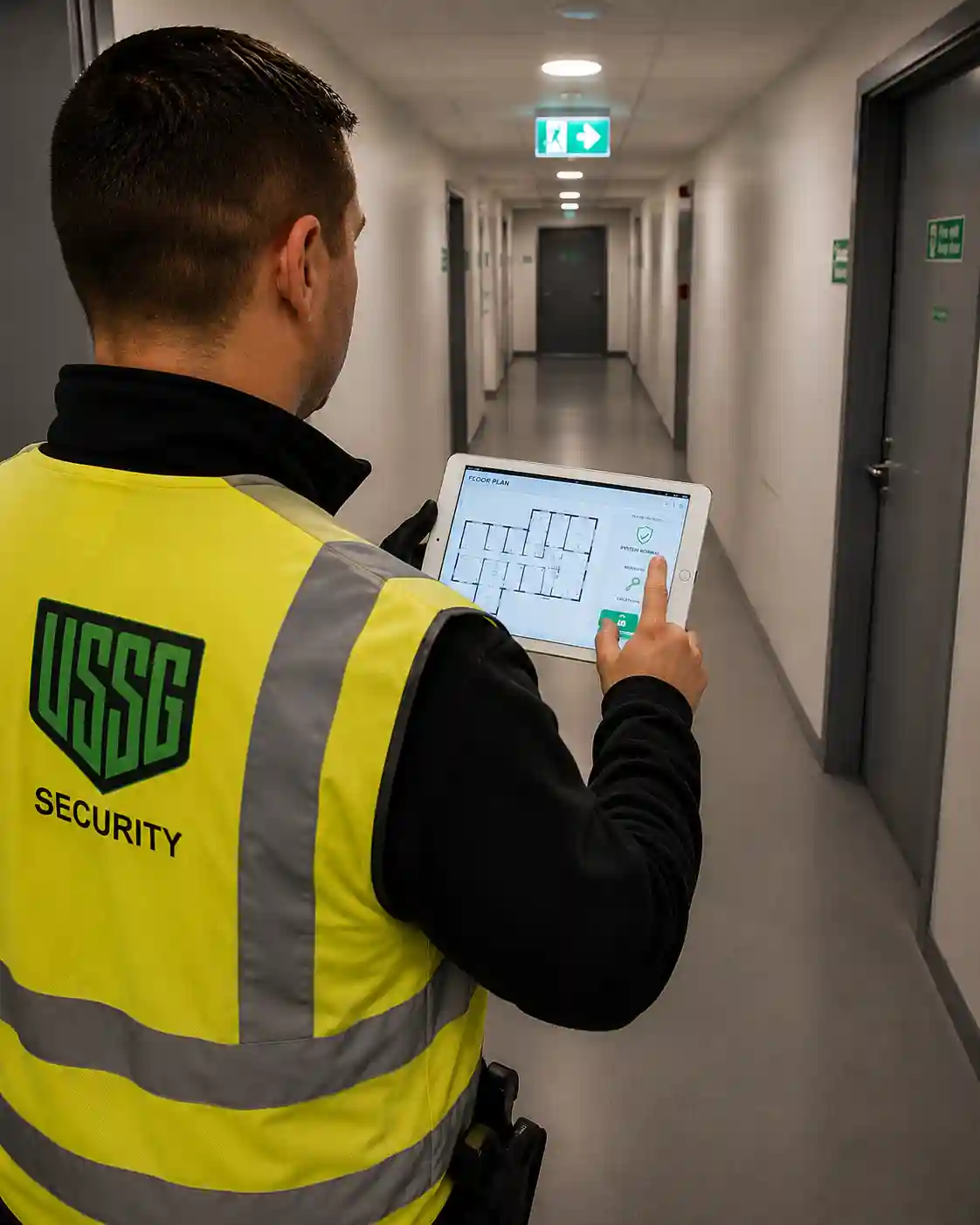
- Checks on site: the officer walks the perimeter and, where agreed, the inside of the building.
- Report: each visit is recorded with the time, the checks completed and anything that needs your attention.
- Escalation: if the officer finds a problem, such as a forced door or an alarm fault, they follow the agreed procedure and contact you or the emergency services.
What does a patrol officer check on each visit?
The patrol brief lists exactly what is checked at your site. Common checks include:
- doors, windows, roller shutters and fire exits are closed and secure
- fences, gates and boundary lines are intact, with no signs of forced entry
- alarm panels are set and show no faults
- external lighting and CCTV cameras appear to be working
- no water leaks, fire risks or obvious damage inside the agreed areas
- vehicles, people or activity that look out of place
Knowing what to look for matters. Our guide on how to spot suspicious activity explains the warning signs patrol officers are trained to notice.
Types of mobile patrol
Scheduled patrols
Visits at fixed times, such as 10pm, 2am and 5am. Useful when checks need to line up with business hours, deliveries or alarm setting.
Random patrols
Visits at varied times each night so that anyone watching the site cannot predict when the officer will arrive. Random visits are a stronger deterrent where a site has already been targeted.
Lock and unlock
The officer opens the premises for staff or contractors in the morning and secures them at the end of the day, then confirms in the report that the building was locked and the alarm set.
Alarm response visits
When the alarm activates, an officer attends to check the building and reset the system where authorised. This is usually combined with key holding and alarm response, so your own staff do not have to attend at night.
Empty building and construction site checks
Regular visits to unoccupied buildings, often alongside vacant property inspections, and out-of-hours checks of fencing, plant and site cabins on construction sites.
Mobile patrols vs a static guard
| Mobile patrol | Static guard | |
|---|---|---|
| On-site presence | Short visits at agreed times | Continuous for the whole shift |
| Best for | Closed or quiet premises, several small sites, lower-risk periods | Busy sites, visitor control, high-value stock, sites never left empty |
| Deterrent | Visible marked vehicle and unpredictable visits | Constant presence that can challenge people straight away |
| Response | Officer attends between visits if an alarm activates | Officer already on site |
| Typical cost | Lower, priced per visit or per month | Higher, priced per officer per hour |
Many sites use both: a static guard during busy hours and mobile patrols overnight or at weekends. Our guide on what manned guarding is explains the static option in more detail.
Who uses mobile patrol security?
- Offices and business units: evening and weekend checks after staff leave, with lock-up and alarm checks.
- Industrial estates and warehouses: night patrols of yards, gates and perimeters. For sites that need someone on the gate, see warehouse security.
- Shops and retail parks: checks of shutters, service yards and car parks after trading hours.
- Construction sites: visits outside working hours to check fencing, plant and materials.
- Empty and void buildings: regular checks for break-ins, squatting, leaks and fire risks.
- Landlords and managing agents: one patrol route covering several properties.
What affects the cost of mobile patrol security?
Mobile patrols are usually priced per visit or as a monthly charge, and they cost much less than a security officer on site for a full shift. The price depends on:
- Number of visits: one lock-up check a night costs less than three random visits.
- Time on site: a quick external check takes less time than a full internal walk-round.
- Location and travel: sites close to an existing patrol route cost less to cover.
- Extra duties: lock and unlock, key holding and alarm response add to the service.
- Days covered: weekends and bank holidays are often charged at a higher rate.
If you are comparing a patrol with a full-time officer, our guide on how much a security guard costs sets out typical 2026 hourly rates for static guarding.
UK licences and standards for mobile patrols
SIA licence
Mobile patrol officers who are supplied under contract to guard premises or property need an SIA Security Guard licence. Holding client keys is a separate licensable activity (key holding), and an alarm call-out that involves guarding the premises needs a front-line licence. Check GOV.UK: find out if you need an SIA licence for the full rules.
BS 7984-3 code of practice
BS 7984-3:2020 is the British Standard code of practice for providing mobile security services. It sits alongside BS 7984-1 for keyholding and response services, and covers how patrols are planned, carried out, recorded and supervised.
BS 7858 screening and the Approved Contractor Scheme
Patrol officers should be screened to BS 7858:2019 before deployment. Providers can also apply to the SIA Approved Contractor Scheme, which checks businesses against a set of quality standards and lists approved contractors on a public register. See our memberships and accreditations.
How to choose a mobile patrol provider
Before you sign, ask each provider:
- Are your officers SIA licensed, screened to BS 7858 and employed directly?
- Is the company an SIA Approved Contractor?
- How will I know each visit happened, and what will the report show?
- Who holds my keys, how are they stored and who can access them?
- How quickly can an officer attend if my alarm activates, and is that written into the contract?
- Where is your patrol team based, and how close is my site to an existing route?
Ask any provider to show you a sample patrol report before you sign. If it only says “all OK”, it is not telling you anything. A good report says what was checked, at what time, and what needs your attention.
Ali Arain, Founder and Chief Executive Officer, USSG
For a wider checklist, read how to choose a security company in the UK.
How USSG provides mobile patrols
Our patrols are carried out by directly employed, SIA-licensed officers screened to BS 7858. Every site starts with a patrol brief that sets out the checks, visit times and reporting, and patrols work well with our key holding and alarm response for the hours between visits.
Patrols are planned from our head office in Stockport for sites across Stockport, Manchester and the surrounding area. For other locations, tell us the postcode and we will confirm what is possible.
To arrange patrols for your premises, see our mobile patrol security service or contact the team.
Frequently asked questions about mobile patrol security
What is the difference between a mobile patrol and a static guard?
A mobile patrol officer visits your premises at agreed times and then moves on to other sites. A static guard stays at your site for the whole shift. Patrols suit closed or quieter premises; a static guard suits busy sites that need someone there all the time.
How many patrol visits does a site need?
It depends on the risk. Many closed premises have one or two visits a night, often a lock-up check in the evening and a random visit in the early hours. Sites that have been targeted may need more frequent, unpredictable visits.
Do mobile patrol officers need an SIA licence?
Officers supplied under contract to guard premises or property need an SIA Security Guard licence. Holding client keys is a separate licensable activity, so check that your provider is licensed for both if you need key holding.
Can a mobile patrol respond to my alarm?
Yes, if the service includes alarm response. The provider holds your keys, receives the alarm notification and sends an officer to check the premises, so your own staff do not have to attend at night.
Will I get proof that each visit happened?
You should. A professional provider records the time of each visit, the checks completed and any issues found, and shares this with you as a patrol report.
Are random patrols better than fixed times?
Random visits are harder to predict, so they are a stronger deterrent where a site is being watched. Fixed times suit tasks that must happen at a set point, such as locking up or setting the alarm. Many sites use a mix.
Can patrol officers check inside the building?
Yes, where access is agreed in the patrol brief. Internal checks can cover alarm panels, fire exits, plant rooms and signs of leaks or damage.