
When we talk about suspicious activity around a business or home, we are not talking about a neighbor walking their dog at an odd hour or a delivery driver turning around in your driveway. True suspicious activity is what security experts call hostile reconnaissance. It is the calculated, quiet homework that criminals do before they attempt a break in. They are looking for your weak spots, measuring how fast your team reacts, mapping out camera locations, and trying to figure out if there are any hours of the day when your building is completely empty.
This scouting process can take days or even weeks. Intruders do not want to get caught, so they will try to blend into the background as much as possible. They might pretend to be lost, dress up as utility workers, or park in nearby blind spots to watch your operations. By understanding that these actions are structured, planned efforts to probe your defenses, you can start looking at your property’s surroundings with a much sharper eye.
Waiting to act until an alarm goes off is a highly expensive way to handle property protection. When an alarm rings at midnight, the physical damage is already done windows are shattered, loading bay doors are bent out of shape, and expensive stock is already being loaded into a getaway vehicle.
The real pain of a successful break in is not just the immediate theft; it is the massive headache of unplanned operational downtime. If your primary gates are broken or your IT server room is vandalized, your entire business can grind to a halt for days while you wait for repairs, resulting in thousands of pounds of lost revenue and massive stress for your staff.
Taking a proactive approach completely shifts your property’s defensive posture. Partnering with an experienced security company near Manchester allows you to stay ahead of the threat and spot these early warning signs before they turn into real world damage.
How to Spot Unusual Foot Traffic and Scouting Tricks
To catch a scout, you have to watch for people who are paying too much attention to your building’s structure rather than its actual business. A normal visitor walks straight to the front reception desk or the main entrance. A hostile actor, however, will wander and linger.
- The Flat Phone Video: Watch out for individuals who walk slowly along your back fences or stop to look at side fire exits. They will often pretend to make a phone call while holding their mobile device completely flat to record video footage of your keypad entry systems, security cameras, or gate locks.
- The Unnatural Tie: Another classic trick is stopping directly underneath a security camera to tie a shoe. They use those extra 30 seconds to look up, study the camera’s angles, and find its exact blind spots.
If someone is loitering near restricted warehouse zones or shipping bays and claims they are “just looking for a restroom” or “waiting for a friend,” trust your gut. Regular visitors do not wander into loading docks by accident.
Spotting Suspicious Vehicles Near Your Boundary
Vehicles are the mobile command centers for property thieves. They provide a warm, hidden space where someone can sit and watch your building for hours without raising immediate alarms. You want to train your eye to look for cars or vans that do not belong to your staff, your customers, or your usual delivery routes.
Keep an eye out for a few specific vehicle behaviors. For example, unmarked white or grey vans parked in dark corners of your parking lot or just outside your fence line with the engine idling for long periods are a major red flag. Often, these vehicles will park facing your main exit gates, giving the driver a direct, unobstructed view of your staff shift changes and keyholder lockup routines.
Pro Tip: Vans with heavily tinted rear windows, vehicles where the driver sits inside for hours without ever stepping out, or cars that drive slowly past your entrance multiple times a day especially during early morning openings or late night closures.
Common Tricks Intruders Use to Get Inside
Not every intruder tries to climb a fence in the dark. Some of the most successful thieves simply walk through the front door during busy business hours. They exploit human politeness and the natural rush of a workplace.
The most common method they use is tailgating closely following an employee through a secure badge access door before the heavy door can swing fully closed.
They also rely heavily on simple disguises to blend in. Someone wearing a cheap, brand new high visibility vest and carrying a blank clipboard can easily mimic construction workers, surveyors, or utility technicians. They might also carry large boxes or hold multiple coffee cups, counting on the fact that your employees will kindly hold the security door open for them. Teach your team that it is always okay to ask to see an ID badge, even if the person looks like they are in a hurry.
Clues That Someone Has Been Probing Your Property
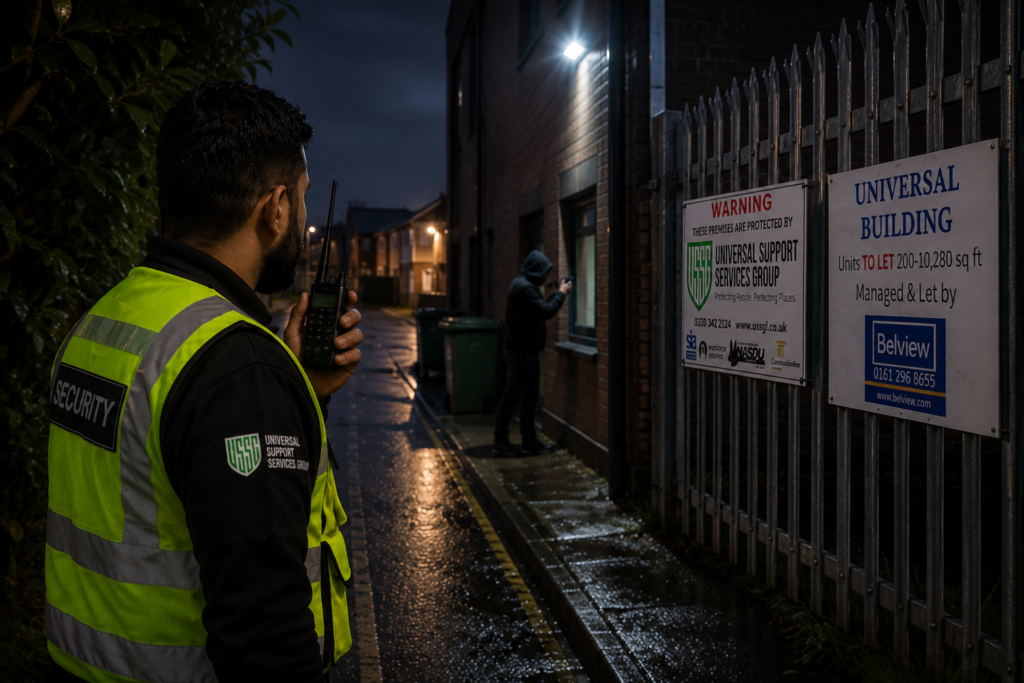
Intruders will often test your physical defenses a day or two before they actually plan to break in. They want to see if your team is actively maintaining the property or if they can create an easy shortcut for their return. Walk your perimeter regularly and look for minor, unnatural changes to your physical layout.
- Latch Blocking: Look for small pieces of duct tape, wood, or cardboard placed over a side door’s latch mechanism to prevent the lock from clicking shut.
- Makeshift Ladders: Keep an eye out for heavy wooden pallets, plastic bins, or tree branches stacked against a back wall, which can be used to scale your fence later that night.
- Hardware Wear: Look closely at padlocks on gates. If they look scratched, have loose mounting bolts, or have had their protective weather covers removed, someone has been testing them.
- Fence Snipping: Check the bottom of chain link fencing. Intruders will often snip just a few links near the ground, creating a small flap that can be easily pushed up to slide underneath.
Detecting Unusual Activity in Your Security Cameras
Your security technology is only useful if it is pointing in the right direction. Intruders know this, and they will often try to disable or adjust your technical systems in advance. If you notice a sudden change in how your security gear is performing, do not just assume it is a technical glitch.
A glaring sign of tampering is an exterior security camera that is suddenly pointing up toward the sky or turned directly toward a blank brick wall instead of the driveway. You should also watch out for motion activated floodlights that are completely dead or have had their bulbs unscrewed or masked with dark spray paint.
If you notice unusual static, sudden blind spots, or frequent disconnects on your digital camera feeds, treat it as an active security issue rather than a simple IT error.
Better Perimeter Security Starts Here
The best way to keep a criminal away from your property is to make it look like a nightmare to break into. When someone scouting the area sees a clean, tightly managed boundary line, they almost always decide your place is far too much trouble and move on to an easier target.
To make this happen, start by hacking down any high bushes, thick weeds, or overgrown trees along your fence line so you do not hand intruders a free place to hide in the shadows. Next, lock your exterior gates down with heavy duty padlocks that have anti cut shackles, and weld the hinge pins shut so nobody can simply lift the gate off its tracks.
You also want to clear away any stacked pallets, ladders, or wheelbins sitting near your walls, because leaving those out is basically giving a thief a free ladder to climb over. Finish things off by putting up clear, professional warning signs along your boundary, making it plain as day that your entire property is under active, constant surveillance.
Improving Your Security Tech and Lighting
Technology and physical presence work hand in hand. By ensuring your technical systems are optimized, you make it almost impossible for anyone to scout your property without being caught on camera.
Start by installing high quality, motion activated LED floodlights in all dark alleyways, shipping bays, and hidden building corners. You also want to position your security cameras high enough that they cannot be reached or tampered with without a ladder, making sure their fields of view overlap to eliminate blind spots.
Finally, utilize automatic closing door hinges and anti passback turnstiles to physically prevent tailgating at your main employee entrances, and check your camera feeds daily to make sure the lenses are clean and the angles have not been altered.
Put Active Surveillance to Work for Your Property
Even the most advanced technology is useless if there is no one there to react when something goes wrong. To truly protect your property, you need human intelligence and rapid action.
Deploying highly visible, uniformed static guards at your main access points serves as an immediate, powerful visual deterrent. You should also utilize random, unpatterned mobile patrol sweeps of your property so that watching scouts can never map out a predictable schedule.
Always set up strict visitor verification protocols at your front desk, requiring every single non employee to sign in, show identification, and wear a visible visitor pass. Lastly, maintain a detailed, shared security log where your staff can instantly record strange license plates, loitering individuals, and fence tampering so that patterns can be spotted early.
Frequently Asked Questions
How can I tell the difference between a lost visitor and someone scouting my property?
A lost visitor will usually look for signs, walk directly toward an entrance, or ask someone for help. A scout will actively avoid eye contact, wander near restricted areas like loading docks or fire exits, and spend an unusual amount of time looking at security cameras, locks, and fences instead of the building’s main entrance.
What should my employees do if they spot a suspicious car parked outside?
Employees should never approach the vehicle or confront the occupants. Instead, they should write down the vehicle’s make, model, color, any visible license plate details, and the time of day, then immediately report this information to site management or your security patrol team.
Why do criminals leave random items like trash cans or pallets near my fence?
This is a common probing tactic. Intruders place these items to see if your maintenance or security teams are actively monitoring the perimeter. If the items are not removed within twenty four hours, the criminal knows your site is unpatrolled and that they can use those items as climbing steps during a break in.
How does tailgating happen, and how can we stop it?
Tailgating happens when an unauthorized person slips through a secure door directly behind an employee who has just swiped their access card. You can stop this by training your staff to never hold secure doors open for people they do not recognize, and by installing rapid closing doors or turnstiles.
Should we use motion activated lights or keep our lights on all night?
A combination of both works best. Keeping key entry points and parking lots continuously illuminated prevents dark blind spots. Adding sudden, bright motion activated floodlights in side alleys or back fences creates a startling visual shock that usually scares off intruders immediately.
What is the danger of relying only on basic burglar alarms?
Basic alarms are reactive; they only sound after a window is smashed or a door is forced open. This means you will still have to deal with physical property damage, stolen inventory, and lost business hours. Proactive security aims to spot and stop the intruder before they ever breach your perimeter.
Why do criminals dress up as utility workers or delivery drivers?
People instinctively trust uniforms, high visibility vests, and clipboards. Criminals use these simple disguises to walk right past front desks, ask questions about building layouts, and search for valuable assets without raising any suspicion from your staff.
What does it mean if a security camera angle has slightly changed?
If a camera is suddenly pointing at the ground, the sky, or a blank wall, it has likely been physically tampered with. Intruders will often use long poles or throw objects to shift camera angles a day or two before a planned break in to ensure their path is completely hidden.
Is it safe for our staff to challenge a stranger wandering inside our building?
Staff should only challenge strangers if they feel entirely safe doing so, and they should always keep a polite, helpful tone. Asking a simple question like, “Hi, can I help you find the reception desk?” is a safe way to let an intruder know they have been spotted and are being watched.
How do random mobile patrols help keep my property secure?
Criminals look for predictable schedules so they can time their break ins. Because professional mobile patrols arrive at completely random, unmapped times throughout the night, they eliminate this predictability, making it far too risky for a thief to attempt an intrusion.
Wrapping Up
Securing your business or commercial property does not require complex military tactics or overwhelming stress. It simply requires a shift in how you look at your daily environment. By learning to spot the quiet, early warning signs of hostile scouting like a car idling in a blind spot, a piece of tape on a door latch, or a stranger trying to slip past your reception desk you take the power away from the intruder. You move from a state of worrying about what might happen to actively controlling who accesses your space.
Protecting what you have built is a continuous journey, but you do not have to walk it alone. Putting simple, daily verification habits in place for your staff, keeping your physical boundaries clean, and relying on professional security experts creates a highly resilient environment. When you make your property a hard target, you gain the ultimate business advantage: complete peace of mind, uninterrupted operations, and a team that feels safe and valued every single day.