
Quick answer: Not always. No UK law says every construction site must have a security guard. But under the Construction (Design and Management) Regulations 2015, the principal contractor must take reasonable steps to stop unauthorised people getting onto the site. On larger, busy or high-value sites, and wherever insurers or clients ask for it, security guards are usually the most reliable way to meet that duty.
Construction sites are easy targets. They hold expensive plant, tools, cable, fuel and materials, they change shape every week, and they are often empty at night and over weekends. The question most project managers ask is not whether security matters, but how much is enough for their site and budget.
This guide explains what the law actually requires, when a site needs security guards and when fencing, CCTV or patrols may be enough, what guards do on site, what it costs, and how to choose a provider. It is written by Universal Support Services Group (USSG), an SIA Approved Contractor and Constructionline Gold member based in Stockport since 2016.
The question is not “do we need a guard?” but “what happens if someone walks onto this site tonight?” If the honest answer is that nobody would know until the morning, the site needs more than a fence.
Ali Arain, Founder and Chief Executive Officer, USSG
In this guide
- What the law says
- When a construction site needs security guards
- When other measures may be enough
- What construction security guards do
- Guards, patrols, CCTV and fencing compared
- How much construction site security costs
- Quick risk checklist
- How to choose a provider
- Frequently asked questions
What does the law say about construction site security?
The main rules come from the Construction (Design and Management) Regulations 2015 (CDM 2015):
- Principal contractor: must ensure that the necessary steps are taken to prevent access by unauthorised persons to the construction site (regulation 13(4)(b)).
- Every contractor: must not start work on a site unless reasonable steps have been taken to prevent unauthorised access (regulation 15(10)).
The law does not say how this must be done. The Health and Safety Executive’s guidance on protecting the public explains that, in populated areas, this usually means a secure boundary such as a two-metre fence or hoarding, with extra measures where children or members of the public could get in.
So guards are not a legal requirement in themselves. They become the right answer when fencing and locks alone cannot reasonably keep people out, or when nobody would notice a break-in until the next morning. Security officers supplied by a contractor must also hold an SIA licence (GOV.UK).
When does a construction site need security guards?
Guards are usually worth it when one or more of these apply:
- High-value plant and materials are stored on site, such as copper cable, fuel, power tools or machinery.
- The site has been targeted before, or neighbouring sites have reported theft or vandalism.
- It sits in a busy or residential area, where children or the public could try to get in.
- Many contractors and deliveries arrive each day, and someone needs to control the gate.
- The site is empty for long periods, such as nights, weekends and the Christmas shutdown.
- Your insurer, funder or client makes manned security a condition of cover or the contract.
- Partly finished buildings could attract squatters, metal thieves or arson.
Our article on why construction sites are becoming theft hotspots explains why these risks have grown.
When other measures may be enough
A small, short or low-value job may not need an officer on site all the time. A mix of these can work instead:
- a secure perimeter fence or hoarding with locked gates
- good lighting and clear warning signs
- secure, alarmed storage for tools and fuel, and immobilised plant
- CCTV with remote monitoring, so alerts are seen in real time
- mobile patrols that check the site at set or random times
- key holding and alarm response, so someone attends when the alarm activates
Many projects use these measures during the day and add a guard at night or at weekends. See our CCTV services and mobile patrol security.
What do construction site security guards do?
Duties are set in the assignment instructions for each site. Typical tasks include:
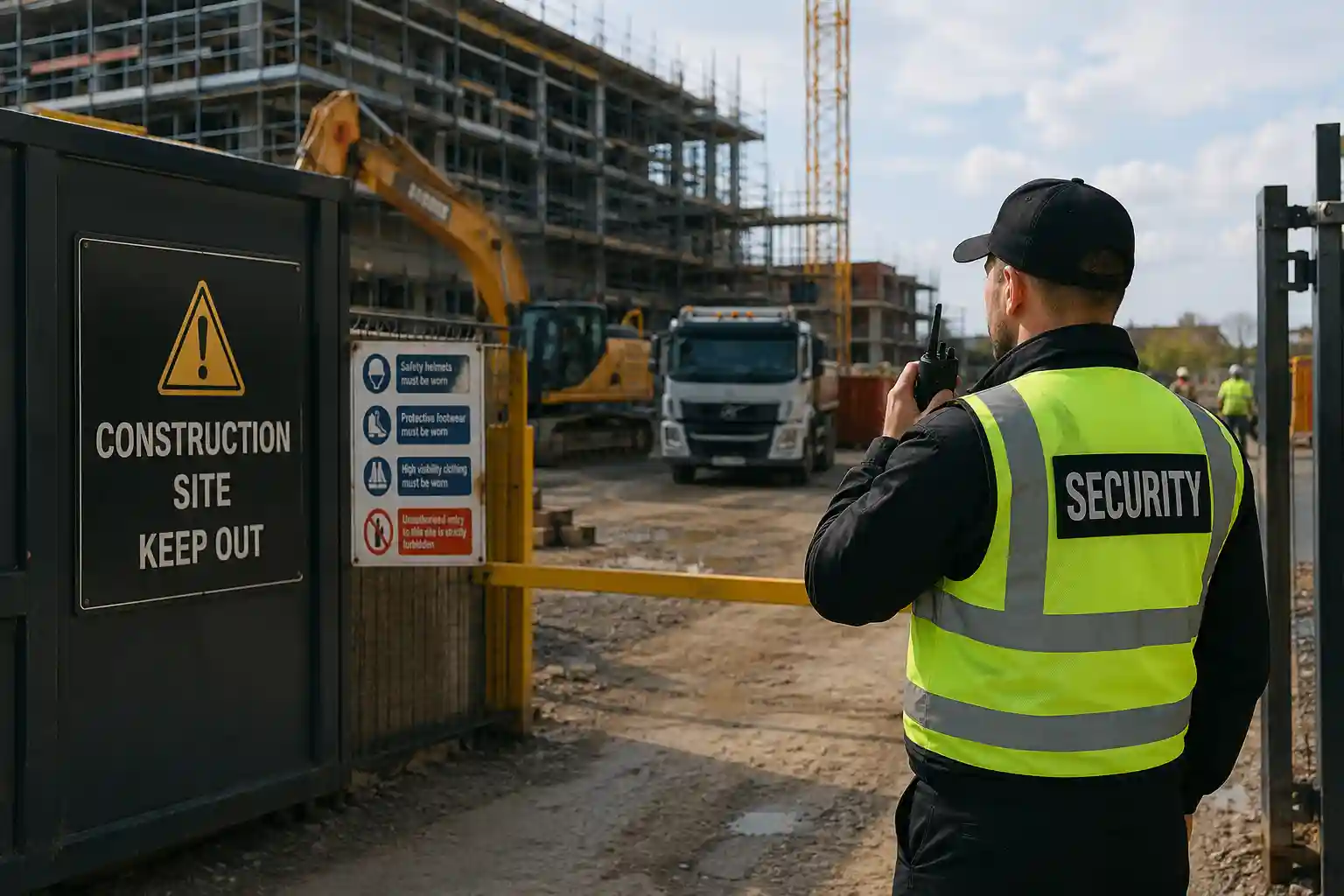
- Gate control: checking people against the site induction list and passes, and refusing entry to anyone not authorised.
- Deliveries: checking vehicles and loads in and out, and recording times and drivers.
- Patrols: walking the perimeter, compounds and buildings, checking fences, hoarding, cabins and plant.
- Opening and lock-up: opening the site for the morning shift and securing it at the end of the day.
- Reporting: recording incidents, damage and hazards, and alerting the site manager.
- Emergencies: raising the alarm and contacting the emergency services if needed.
Guards, patrols, CCTV and fencing compared
| Measure | What it does | Best for | Limits |
|---|---|---|---|
| Security guard | Officer on site for agreed hours | Busy, high-value or targeted sites; gate control | Higher cost than other options |
| Mobile patrol | Officer visits at set or random times | Quieter sites, nights and weekends | Nobody on site between visits |
| Monitored CCTV | Cameras watched remotely, with alerts | Large open sites, evidence | Cannot physically stop an intruder |
| Fencing and hoarding | Physical barrier around the site | Every site; the legal starting point | Can be climbed, cut or left open |
How much does construction site security cost?
Security guards are priced per officer per hour. As a guide, daytime cover typically costs:
| Region | Typical hourly rate |
|---|---|
| Rural areas and small towns | £18 |
| Provincial towns and smaller cities | £18 to £20 |
| Major cities (Manchester, Birmingham, Glasgow) | £18 to £25 |
The final price depends on the hours, the number of officers, the site risk and the length of the contract. Patrols and monitored CCTV usually cost less than a full-time officer. Our guide on how much a security guard costs explains what is included in the rate.
Quick risk checklist
Answer yes or no. The more “yes” answers, the stronger the case for security guards:
- Is there plant, cable, fuel or materials on site worth more than the cost of a few weeks of security?
- Has the site, or a site nearby, had theft, vandalism or trespass?
- Is the site in a residential area or near a school?
- Do more than a few contractors or deliveries arrive each day?
- Will the site be empty for long periods, such as nights, weekends or holidays?
- Does your insurer, funder or client require security?
How to choose a construction site security provider
- Is the company an SIA Approved Contractor, with officers screened to BS 7858?
- Does it have experience on construction sites, and can it show references?
- Will officers complete your site induction and follow your PPE rules?
- How are patrols and incidents recorded and reported to you?
- What is the plan if an officer is ill or a shift is missed?
- Does the company hold the right insurance and supply-chain accreditations, such as Constructionline?
Ask how the provider will cover the last hour of the day and the first hour of the morning. That is when sites are most often left open by mistake, and when most avoidable losses start.
Ali Arain, Founder and Chief Executive Officer, USSG
Our guide on how to choose a security company in the UK has a full checklist.
How USSG secures construction sites
USSG provides construction site security with directly employed, SIA-licensed officers screened to BS 7858. We are an SIA Approved Contractor for security guarding and key holding, and a Constructionline Gold member. Site induction, PPE and reporting are agreed before the first shift.
We manage work from our head office in Stockport and take enquiries for sites across the UK. For a practical, step-by-step approach, read how to secure construction sites in Manchester, or contact the team to discuss your project.
Frequently asked questions about construction site security
Is it a legal requirement to have security on a construction site?
There is no legal requirement to have a security guard. CDM 2015 requires the principal contractor to take the necessary steps to prevent unauthorised access, which usually means a secure boundary at least. Guards are one way to meet that duty on higher-risk sites.
Who is responsible for construction site security?
Under CDM 2015, the principal contractor must take steps to prevent unauthorised access, and every contractor must not start work until reasonable steps are in place. The client also has a duty to make suitable arrangements for managing the project.
Do construction site security guards need an SIA licence?
Yes, if they are supplied under contract to guard the site. They need an SIA Security Guard licence and must wear it while working.
Is CCTV enough for a construction site?
Monitored CCTV is a strong deterrent and provides evidence, but it cannot physically stop an intruder. Many sites combine CCTV with mobile patrols or a guard at night and at weekends.
When do construction sites need security the most?
Nights, weekends, bank holidays and the Christmas shutdown, plus the early phases when materials and plant are delivered but the building is not yet secure.
How much does a construction site security guard cost?
Typically £18 an hour in rural areas and small towns, £18 to £20 in provincial towns and £18 to £25 in major cities such as Manchester, Birmingham and Glasgow. London, nights, weekends and bank holidays cost more.
Can security cover be changed as the project progresses?
Yes. Many projects start with patrols or CCTV, add a gate officer when deliveries increase, and keep night cover until the building is handed over.